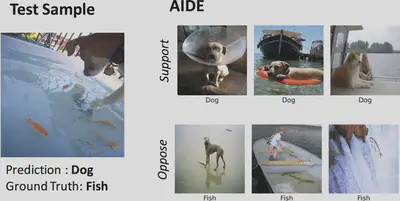
For many use-cases, it is often important to explain the prediction of a black-box model by identifying the most influential training data samples. We propose AIDE, Antithetical, Intent-based, and Diverse Example-Based Explanations, an approach for providing antithetical (i.e., contrastive), intent-based, diverse explanations for opaque and complex models. AIDE distinguishes three types of explainability intents: interpreting a correct, investigating a wrong, and clarifying an ambiguous prediction. For each intent, AIDE selects an appropriate set of influential training samples that support or oppose the prediction either directly or by contrast. To provide a succinct summary, AIDE uses diversity-aware sampling to avoid redundancy and increase coverage of the training data.